What SB 326 Means for Redondo Beach Condo Financing
August 20, 2026
August 20, 2026
If you own a condo along the Esplanade or near King Harbor, you probably already know about the balcony law. Every HOA board in California has spent the past two years talking about it, and the deadline to comply passed a year and a half ago. So if your building did its inspection, you might reasonably think the compliance question is behind you.
It isn't. A second deadline landed earlier this month, and it changes what that old inspection report is actually worth to a buyer's lender. The two rules were never designed to interact, but in a building stock as old as Redondo Beach's Esplanade corridor, they are now doing exactly that, and the collision is starting to show up as denied loans and canceled escrows rather than HOA meeting minutes.
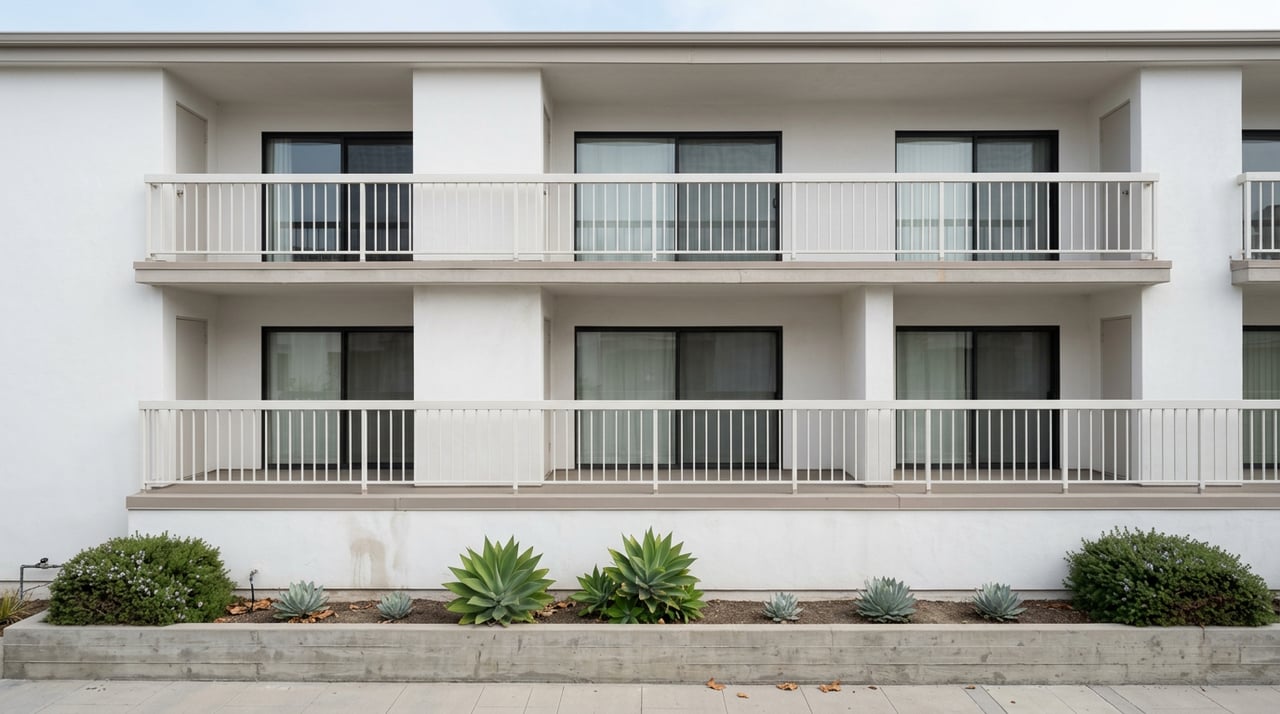
Senate Bill 326 added Civil Code Section 5551 to the Davis-Stirling Act, requiring California condominium associations with three or more units to inspect load-bearing balconies, decks, stairways, and walkways supported substantially by wood. The first inspection was due by January 1, 2025, with no extension. That last part matters because a companion law for apartment buildings, SB 721, did get a one-year reprieve to January 1, 2026 under AB 2579, and a lot of confused HOA boards assumed the same grace period applied to them. It did not.
Redondo Beach's beachfront corridor is exactly the kind of building stock this law was written for. The Sand Castle went up in 1971 with 95 units and six stories of oceanfront balconies. Ocean Plaza, the 10-story tower at 531 Esplanade, dates to 1974 with 80 units. Casa Bahia followed two years later with 54 units in a five-story stucco building. San Simeon at 625 Esplanade is a 1974 build with a mix of one to three bedroom units, and Seascape Condos rounds out the list with 171 units built in 1980. None of these buildings were constructed with the concrete-and-steel elevated elements you'd find in newer coastal construction. Legal guidance on the statute notes that in a typical California condominium project, the wood-support qualifier sweeps in nearly every elevated structure on the property, which means buildings from this era are rarely exempt.
The inspection itself was never the expensive part. The expensive part is what happens to a building's insurance and financing once the report exists, or once its absence becomes impossible to hide.
Insurance carriers are now requiring proof of SB 326 compliance before renewing master policies, and HOA attorneys tracking the fallout have reported premium increases running from 100 to 400 percent in affected buildings. One case detailed in industry reporting involved a lender that classified routine, non-emergency repair recommendations from an SB 326 report as critical repairs and refused to finance a pending sale outright. Another account referenced a special assessment as high as $175,000 per unit in a Southern California beach city after a board deferred the inspection and the resulting repairs came due all at once.
That is the mechanism worth understanding if you own or are considering a unit in one of these buildings. The inspection report is no longer a maintenance document that sits in a filing cabinet. Under SB 410, passed in 2025, it must be incorporated into the HOA's reserve study and disclosed to prospective buyers as part of that packet. A lender reading that report during underwriting can decide, on its own judgment, whether what it finds counts as routine upkeep or a red flag serious enough to kill the loan.
A condo does not stop being financeable because a board deferred a repair. It stops being financeable because a lender can now read exactly what was deferred, and the report says so in writing.
Here is where the timing gets specific to right now. On August 3, 2026, Fannie Mae eliminated the Limited Review approval path for condo loans in buildings with 11 or more units. Limited Review used to let a buyer putting down 25 percent or more close without a full investigation of the building's finances or deferred maintenance. As of this month, every loan in an 11-plus unit building requires Full Review, which means underwriters are now looking directly at reserve fund levels, outstanding special assessments, and owner-occupancy ratios before they will back a loan.
The new reserve standard requires funding of at least 10 percent of a building's annual assessments, with full compliance required by January 2027. A building collecting $800,000 a year in dues would need to show at least $80,000 earmarked and documented in reserves. On top of that, a minimum insurance coverage requirement took effect July 1, 2026, meaning a building whose master policy has not been updated to meet the new thresholds can fail that test on its own, independent of anything balcony-related.
Here is the part that turns two unrelated rules into one problem. Buildings that completed their SB 326 inspections in 2025 and found repairs they needed to make often paid for that work out of reserves. Spending reserve funds on balcony remediation is exactly what the law wanted boards to do. But it also means some of these same buildings are walking into the new Fannie Mae reserve test underfunded, at the precise moment Limited Review disappeared and Full Review became mandatory.
| Before August 3, 2026 | After August 3, 2026 | |
|---|---|---|
| Review type for 11+ unit buildings | Limited Review available with 25%+ down | Full Review required for every loan |
| What lenders check | Basic HOA standing | Reserve levels, deferred maintenance, occupancy ratio |
| Reserve funding standard | No fixed federal minimum | 10% of annual assessments, compliant by Jan 2027 |
| Master insurance coverage | Case by case | Minimum coverage thresholds in effect since July 1, 2026 |
None of this means these buildings have stopped selling. It means the reason a deal falls apart has shifted from "will a buyer want this unit" to "will a lender agree to finance it." Condos and townhomes along Harbor Drive and Catalina Avenue near King Harbor still trade well above a million dollars for water-view units, and beachfront Esplanade sales have continued setting records this year, including a two-bedroom that closed above $2 million in January. Inland North Redondo condos, which tend to be in smaller, lower-density buildings less likely to trigger the 11-unit Full Review threshold, have generally traded in the $600,000 to $900,000 range with fewer of these financing complications.
That gap is the real story. It is not that Esplanade condos are less desirable than they were a year ago. It is that a building's HOA paperwork now determines its buyer pool in a way it never did before, and a listing that looks identical to one two doors down can sell in weeks or sit for months depending entirely on what a lender finds in the reserve study.
If you are selling in one of these buildings, or writing an offer on a unit in one, the documents below are worth requesting before you are deep into escrow, not after.
Getting this packet organized before a listing goes live changes the leverage in the transaction entirely. A buyer who discovers a compliance gap mid-escrow has room to renegotiate or walk. A buyer who sees a complete, documented file on day one is underwriting against known facts instead of open questions.
Does this apply if my building has fewer than 11 units? The August 3 Fannie Mae change specifically targets 11-plus unit buildings, so many of the smaller courtyard-style condo and townhome projects in North Redondo fall outside Full Review. SB 326 compliance still matters for insurance purposes regardless of size, as long as the building has three or more units with qualifying elevated elements.
What if my HOA already completed the inspection and made the repairs? That puts you ahead of most buildings in this corridor, but it is worth confirming the report was formally folded into the reserve study, since that documentation is what a Full Review underwriter will ask to see.
Is this only a Redondo Beach issue? The two rules apply statewide, but they land hardest on cities with a concentrated stock of 1970s and 1980s oceanfront condo towers, which describes Redondo Beach's Esplanade and King Harbor corridor about as precisely as anywhere in the South Bay.
If you are trying to figure out where your building or your target building stands on any of this before you list or make an offer, that is exactly the kind of groundwork Lisa Moule Realty does before a client ever signs anything. Schedule your South Bay consultation and we will walk through the HOA file together, line by line, before it becomes someone else's surprise.
Stay up to date on the latest real estate trends.



Get assistance in determining current property value, crafting a competitive offer, writing and negotiating a contract, and much more. Contact Lisa today to discuss all your real estate needs!